
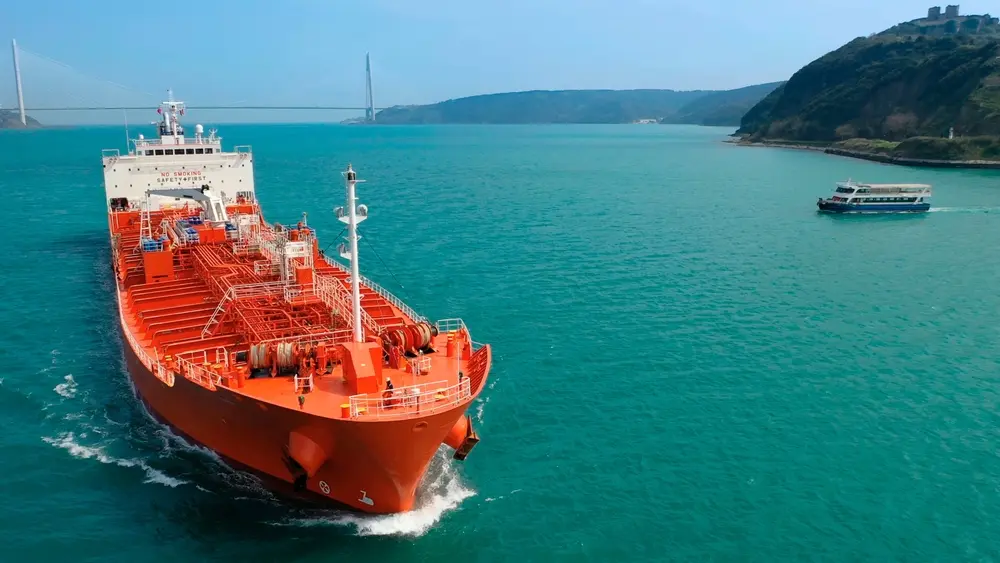
A chemical tanker (often called a chemical carrier or chemical ship) is a vessel purpose-built to carry liquid chemicals in bulk under tightly controlled safety and contamination-prevention standards. Unlike crude or product tankers that typically carry a narrower range of hydrocarbon cargoes, chemical tankers are designed for “parcel” trading: multiple different substances loaded simultaneously in segregated tanks, each with its own handling requirements.
This guide explains what chemical tankers transport, how they’re classified (IMO Types 1/2/3), and the operational and compliance challenges that come with chemical tankers shipping, especially in ports where documentation, inspections, and terminal interfaces are complex.
Definition of chemical tanker
A chemical tanker is a tanker constructed and equipped to transport liquid chemicals listed in the International Bulk Chemical (IBC) Code, as well as certain petroleum products and other liquid bulk cargoes that require specialised containment, materials, and procedures. In practice, “chemical transport” by sea includes everything from relatively low-hazard solvents to highly hazardous toxic or reactive chemicals that demand the highest containment standards.
What do chemical tankers transport?
Chemical tankers transport a wide range of cargo groups, typically including (depending on vessel specification and tank materials/coatings): alcohols and glycols, caustic soda solutions, acids, certain clean petroleum products, aromatics, and specialty chemicals used in industrial supply chains.
How do they differ from oil or product tankers?
A chemical tanker differs from oil/product tankers in several practical ways:
- Higher segregation capability: more (and smaller) cargo tanks, independent piping runs, and strict separation between cargo systems.
- Materials and coatings: stainless steel tanks or advanced coatings to resist corrosion/absorption and reduce contamination risk.
- Cargo-handling equipment: deepwell pumps (often one per tank), dedicated stripping arrangements, vapour control interfaces, and temperature management where needed.
- Operational discipline: cargo compatibility, tank-cleaning standards, prewash requirements for certain cargoes, and stringent sampling/certification routines.
Types of chemical tankers
Chemical tankers are commonly referenced by IMO ship type (Type 1, 2, or 3) under the IBC framework, which reflects the hazard level of cargoes the vessel may carry and the protective measures required in the ship’s design.
IMO Type comparison table (Type 1 vs Type 2 vs Type 3)
| IMO Type | Hazard level of cargo permitted | Typical chemical examples | Structural requirements | Environmental protection level | Tank segregation capability |
| IMO Type 1 | Highest hazard cargoes (most stringent containment) | Very toxic / high-risk chemicals (varies by IBC listing) | Tanks located further inboard; highest damage stability/containment standards | Highest (minimised spill risk in collision/grounding) | Typically high on vessels trading Type 1 cargoes; strict separation and control expected |
| IMO Type 2 | Medium-to-high hazard cargoes | Common industrial chemicals requiring robust controls (varies by IBC listing) | High protective location and structural integrity, less stringent than Type 1 | High | High on parcel carriers; multi-parcel segregation is a core design feature |
| IMO Type 3 | Lower hazard cargoes (relative, still regulated) | Less hazardous bulk liquids and some clean petroleum-compatible cargoes (varies by IBC listing) | Standard protective location requirements within chemical tanker rules | Moderate-to-high | Moderate-to-high depending on parcel design; often fewer restrictions than Types 1/2. |
IMO Type 1
Type 1 vessels are intended for the most hazardous chemicals identified by the IBC Code, requiring the greatest degree of cargo containment and protective tank location. Operationally, these voyages tend to attract heightened scrutiny from terminals and authorities: documentation completeness, compatibility confirmation, emergency readiness, and ship/shore safety alignment are non-negotiable.
IMO Type 2
Type 2 is widely used in international chemical tankers shipping for medium-to-high hazard cargoes. These ships are often built for flexible parcel operations, with extensive segregation (tanks, pipelines, pumps) and robust safety systems. Many “workhorse” chemical carriers in Europe/Mediterranean trade fall into this category.
IMO Type 3
Type 3 covers lower hazard chemicals compared with Types 1 and 2, though the cargoes remain regulated under IBC-related provisions. Type 3 vessels may operate on regional and short-sea routes, sometimes combining chemical parcels with compatible clean products depending on ship specification and charterparty restrictions.
Design and construction of chemical tankers
The engineering of a chemical tanker is driven by a single objective: carry diverse cargoes safely without reaction, contamination, leakage, or uncontrolled vapour release.
Tank materials and coatings
Two dominant approaches exist:
- Stainless steel cargo tanks: strong chemical resistance, easier cleaning to high purity standards, and reduced cargo absorption.
- Coated tanks: lighter and cost-efficient but require strict compatibility management and coating condition monitoring to avoid cargo damage or contamination.
Cargo tank layout and segmentation
Parcel chemical carriers rely on segmentation: multiple tanks, independent lines, and valve segregation to carry different substances simultaneously. This is where the “chemical tanker guide” mindset becomes practical: compatibility isn’t theoretical,it dictates how the loading plan is built, which manifolds are used, and how cross-contamination is prevented during stripping and line displacement.
Safety systems and redundancies
Chemical tanker safety is built around layered protection: closed loading capability, vapour control interfaces where required, tank atmosphere management (including inerting/nitrogen padding for certain cargoes), overfill prevention, high-level alarms, controlled venting systems, and robust emergency shutdown alignment with the terminal.
Chemical tanker operations
Chemical tanker operations are process-driven. The “cargo operation” starts long before the ship reaches port, with cargo nomination, compatibility checks, terminal acceptance, and pre-arrival documentation.
Loading and unloading procedures
Typical operational steps include pre-transfer safety meetings, manifold connection checks, line-up verification, controlled ramp-up of flow rates, continuous monitoring (pressure, temperature, tank levels), sampling and sealing routines, and strict adherence to the agreed ship/shore plan. Because many chemical cargoes are sensitive to temperature and contamination, operators often use dedicated hoses/arms and defined sequences to prevent backflow and mixing.
Tank cleaning and gas-freeing
Tank cleaning is one of the defining complexities of chemical transport. Cleaning method selection depends on prior cargo, next cargo, coating, water availability, and required cleanliness standard (including wall-wash tests for some cargoes).
Gas-freeing is tightly controlled due to toxic and flammable vapours, and its timing can directly affect berth productivity and inspection readiness. Poor planning here is a common root cause of port delays.
Regulatory compliance (IBC Code, MARPOL)
Beyond onboard procedures, chemical tanker calls frequently involve permits, declarations, and coordination with port and customs authorities. Managing these interfaces is often as critical as the cargo operation itself, particularly when hazardous cargo classifications and multiple parcels are involved. In practice, aligning vessel documentation, terminal requirements, and authority expectations may require dedicated regulatory documentation support to ensure submissions are complete, consistent, and accepted without delays.

Regulatory compliance table (codes and regulations relevant to chemical tankers)
| Code / Regulation | Main focus | Applicability to chemical tankers |
| IBC Code | Construction/equipment standards and carriage requirements for bulk liquid chemicals | Core framework defining IMO ship type, cargo lists, containment, safety features |
| MARPOL (chemical-related provisions, incl. NLS controls) | Pollution prevention, discharge restrictions, residues and prewash regimes | Governs how chemical residues and wash water are handled and discharged/retained |
| SOLAS | Ship safety: fire protection, life-saving, hazardous areas, operational safety | Critical for tanker safety systems, fire protection, and emergency readiness |
| ISM Code | Safety management systems and operational risk control | Requires structured procedures, training, and continuous improvement for tanker operations |
| STCW (tanker-related training) | Competency and certification standards for seafarers | Ensures crew are trained for chemical tanker hazards and cargo handling duties |
| ISPS Code | Ship and port facility security | Impacts port entry processes, access control, and documentation during port calls |
Role of shipping agents in chemical tanker operations
In chemical tanker calls, the agent’s role is fundamentally operational: coordinating stakeholders, anticipating constraints, and ensuring compliance steps happen in the right order and on time. This becomes even more critical when dealing with multiple parcels, multiple consignees, tight berth windows, mandatory surveys, or last-minute cargo changes.
A capable local agent helps by aligning terminal requirements with vessel readiness, coordinating authorities (port state, customs, harbour master), and managing the frictions that cause delays: berth changes, pilotage constraints, tank-cleaning timing, slops disposal arrangements, or documentation amendments. In practice, not every party can coordinate these calls properly-chemical operations require local knowledge and strong port-side coordination.
Within Ibérica Marítima’s scope as a shipping agent, the value added is primarily in logistics coordination and regulatory alignment: ensuring that chemical tanker operations remain predictable, compliant, and defensible in front of terminals and authorities, especially when the situation becomes complex.
Routes and global trade relevance
Chemical shipping underpins industrial supply chains. Demand is closely linked to manufacturing clusters, refinery/petrochemical capacity, and regional consumption of intermediates.
Major export-import corridors
Key corridors often include: North-West Europe to the Mediterranean; US Gulf to Europe and Latin America; Middle East to Asia; intra-Asia routes centered on major hubs; and Europe to West Africa for specific industrial and consumer chemicals. The corridor choice is shaped by parcel economics, tank availability, and port capability (including reception facilities and inspection capacity).
Ports specialized in chemical cargo
Specialised chemical ports tend to share features: strong terminal safety culture, compatible infrastructure (dedicated lines, vapour control where needed), surveyor availability, and reliable reception facilities. In Europe, major chemical clusters support port specialisation; in Spain, certain industrial ports handle significant chemical volumes due to local petrochemical ecosystems and storage capacity.
FAQs about chemical tankers
H3 Can a chemical tanker carry multiple substances?
Yes. Many chemical tankers are designed as parcel carriers, meaning they can carry multiple substances simultaneously in segregated tanks—provided compatibility, segregation, and charterparty/terminal requirements are met.
How is contamination prevented?
Prevention relies on segregation (tanks/lines/pumps), strict loading sequences, controlled line displacement, tank-cleaning standards, coating management, sampling protocols, and documentation discipline (so the declared cargo and actual handling match).
What certifications are required?
Chemical tanker compliance generally requires the vessel to meet IBC-related certification, SOLAS safety requirements, and applicable MARPOL pollution-prevention provisions, with crew holding tanker-related competencies under STCW. Specific cargoes and terminals may impose additional vetting or inspection requirements.